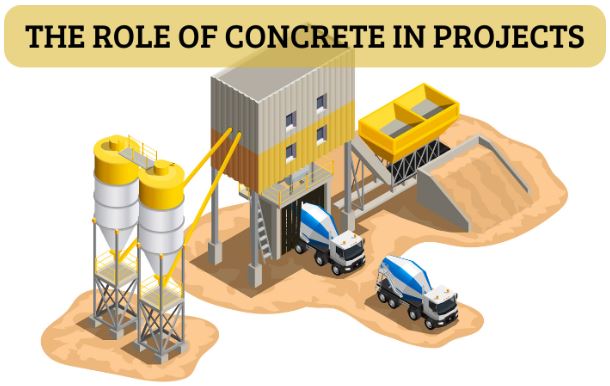
The Role of Concrete in Resilient Infrastructure Development
Concrete is known as the main building material and due to longevity and power, this is considered essential in different infrastructure projects including roads, bridges, dams, and buildings, and saves these from external threats. Concrete can endure harsh environmental conditions like earthquakes, hurricanes, floods, polar ice caps, the driest spots in deserts, and abysmal depths in the ocean.
Moreover, the lifespan and the minimal maintenance help to make the infrastructure and bolster their resilience against further obstacles. The free and online concrete calculator is developed to estimate the amount of concrete required for a project. In this article, we have a detailed overview so let us continue a little bit further toward the explorations and see what else we can uncover.
ALSO READ : Concrete Water Tank Construction
Role of Concrete In Sustainable Development:
In the simplest form, we say that concrete is a mixture form of paste and aggregates. A layer of Portland cement and water is covered the surface of fine aggregate. But here the most arising question is how this paste hards? The answer is simple. This most demanding factor of infrastructure development hardens through the chemical reaction known as hydration. After this reaction, this paste gets strength like a rock-like mass.
In sustainable development, the concrete calculator plays a crucial role in determining the amount of concrete that is needed for a specific project. Therefore, the ability to be used in various applications makes it prominent in sustainable buildings. Providing strong eco-friendly projects, cement contributes to longevity and brings down the need for frequent repairs and replacements.
ALSO READ : Green Concrete - An Eco Friendly Concrete Substitute
| Cement Compound | Weight Percentage | Chemical Formula |
| Tricalcium silicate | 50 % | Ca3SiO5 or 3CaO.SiO2 |
| Dicalcium silicate | 25 % | Ca2SiO4 or 2CaO.SiO2 |
| Tricalcium aluminate | 10 % | Ca3Al2O6 or 3CaO .Al2O3 |
| Tetracalcium aluminoferrite | 10 % | Ca4Al2Fe2O10 or 4CaO.Al2O3.Fe2O3 |
| Gypsum | 5 % | CaSO4.2H2O |
How Does Concrete Contribute To Global Warming?
The manufacturing industries keep in view the greenhouse effects at the time of cement manufacturing. These industries contribute directly to the production of CO2 (carbon dioxide) when CaCO3 (Calcium Carbonate) is thermally decomposed.
The cement-making process uses high temperatures and to produce cement they heat the ingredients at that temperature and also this process requires a lot of energy. The heating of cement kilns to around 40% of the industry's carbon emission, and these components are heated at about 1300-1450 °C (2372- 2642 °F)
| Metric | Value |
| Percentage of Global CO2 Emissions from Cement Production | 8% |
| Average Lifespan of Concrete Bridges (in years) | 75 |
| Reduction in Life Cycle Costs of Concrete Pavements compared to Asphalt | 20-40% |
| Amount of Energy Saved by Using Recycled Aggregate in Concrete Production | Up to 25% |
| Increase in Durability of Concrete Structures with Proper Maintenance | Up to 50 years |
| Growth Rate of Global Construction Industry (2019-2025) | 4.2% annually |
| Increase in Concrete Consumption in Emerging Economies (2020-2030) | 80% |
| Percentage of Infrastructure Investments Allocated to Concrete Projects | 60% |
| Number of Jobs Created per $1 Million Invested in Concrete Infrastructure | 9-14 |
| Estimated Global Concrete Production (2021) | Over 4.5 billion metric tons |
Characteristics of Concrete in Resilient Infrastructure:
Use the concrete calculator to quickly and accurately determine how many bags, yards, or cubic meters you need of concrete to complete and strengthen your project. In the resilient infrastructure, there are a lot of benefits of using concrete. So look at these properties:
- Outstanding strength along with durability to bear heavy loads and extreme environmental conditions.
- It has a low permeability value that proves helpful in preventing water and chemical penetration. This method reduces the risks of corrosion.
- As we know it is a flexible product so to prevent cracking under stress we can also use cement.
- In the case of fire resistance, the Portland cement maintains the structural integrity and helps to protect the structure.
- The sustainable and environmentally friendly material ensure the longevity of service life and reduces the materials costs.
Understanding Concrete Mix Ratios
Concrete mix ratio is the combination of various materials and understanding ratios is considered important to determine the durability and strength. The common ratios are as follows:
-
1:2:4 - This mix ratio is composed of (1 part of cement, 2 parts of sand, and 4 parts of gravel). This combination is generally used in sidewalks, driveways, and footings.
-
1:3:6 - This ratio of cement is composed of (1 part cement, 3 parts of sand, 6 parts of gravel or smashed stone). Generally, this combination is utilized in average construction projects including slabs, columns, and foundations.
-
1:1.5:3 - This mixture of concrete ratio comprises (1 part of cement, 1.5 part s of sand, 3 parts of compressed stone or gravel). In patios, walkways, and stairs this ratio is generally used.
Final Discussion:
In conclusion, we have analysed that concrete is a product of various materials that play a prominent role in building resilient infrastructure. This is a strong and durable material which can face natural disasters along with harsh weather conditions. Overall the role of concrete lies in the capacity to support the challenges to meet the needs of present and future generations.
The user-friendly concrete calculator takes into account the depth, width, length, and unit price and determines the amount of concrete to develop a foundation. In any construction, the usage of concrete strengthens the overall infrastructure against damage during a crisis.